MOLECULAR INTELLIGENCE, WORKING TOGETHER
A conversation
with chemistry.
From a question to a molecular structure.
Four specialists, coordinated through one
research conversation.
A research prototype for molecular design and analysis.
01 / THE APPROACH
Different expertise.
Shared direction.
Molecular questions rarely fit into a single task. MolCrew brings the right specialist into the conversation, then uses chemistry tools to examine the result.
A language-model orchestrator interprets your request, coordinates specialist models, and can repeat an editing and feedback cycle. RDKit checks structure validity and calculates molecular descriptors.
Ask in your own words
Begin with a description, a question, or a SMILES structure.
Bring in the specialists
The orchestrator chooses the tools for the task.
Examine. Then refine.
Review structures, descriptions, and available property outputs.
02 / POSSIBILITIES
One starting point.
Many ways to explore.
Move between language and structure,
with the research question in view.
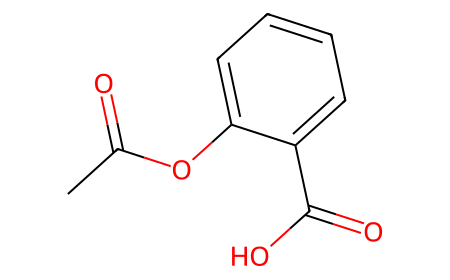 ASPIRIN / C₉H₈O₄
Prepared interface example. No live model request was run.
03 / THE STORY
See the pieces
come together.
A short introduction to the MolCrew workflow.
A narrated story of questions, molecules, and discovery.
BUILT FOR EXPLORATION
Make the next question
a better one.
MolCrew supports molecular research. Generated structures and learned predictions are hypotheses to investigate. Structure checks and calculated descriptors do not establish synthesis feasibility, biological activity, or clinical safety.